


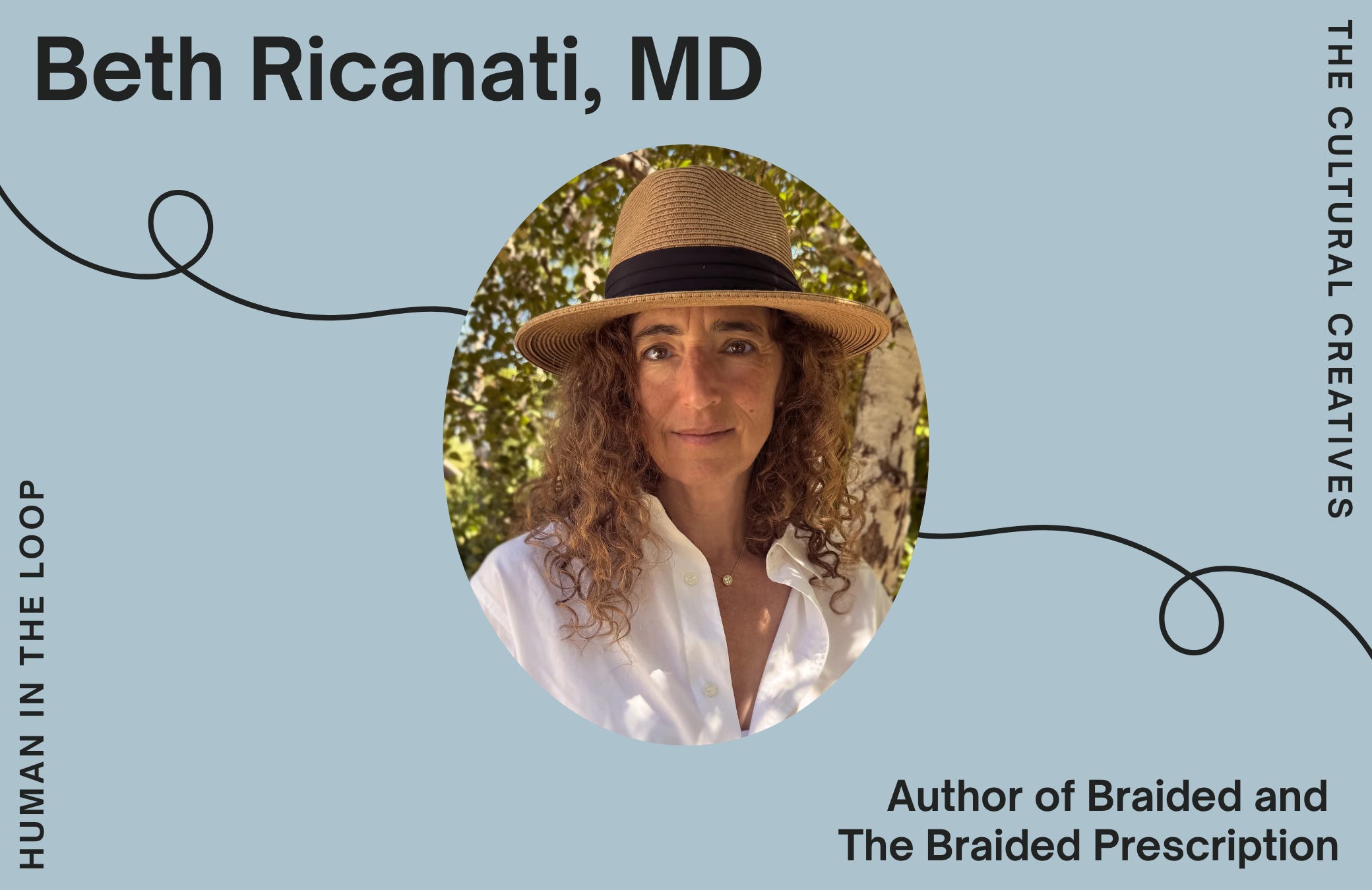
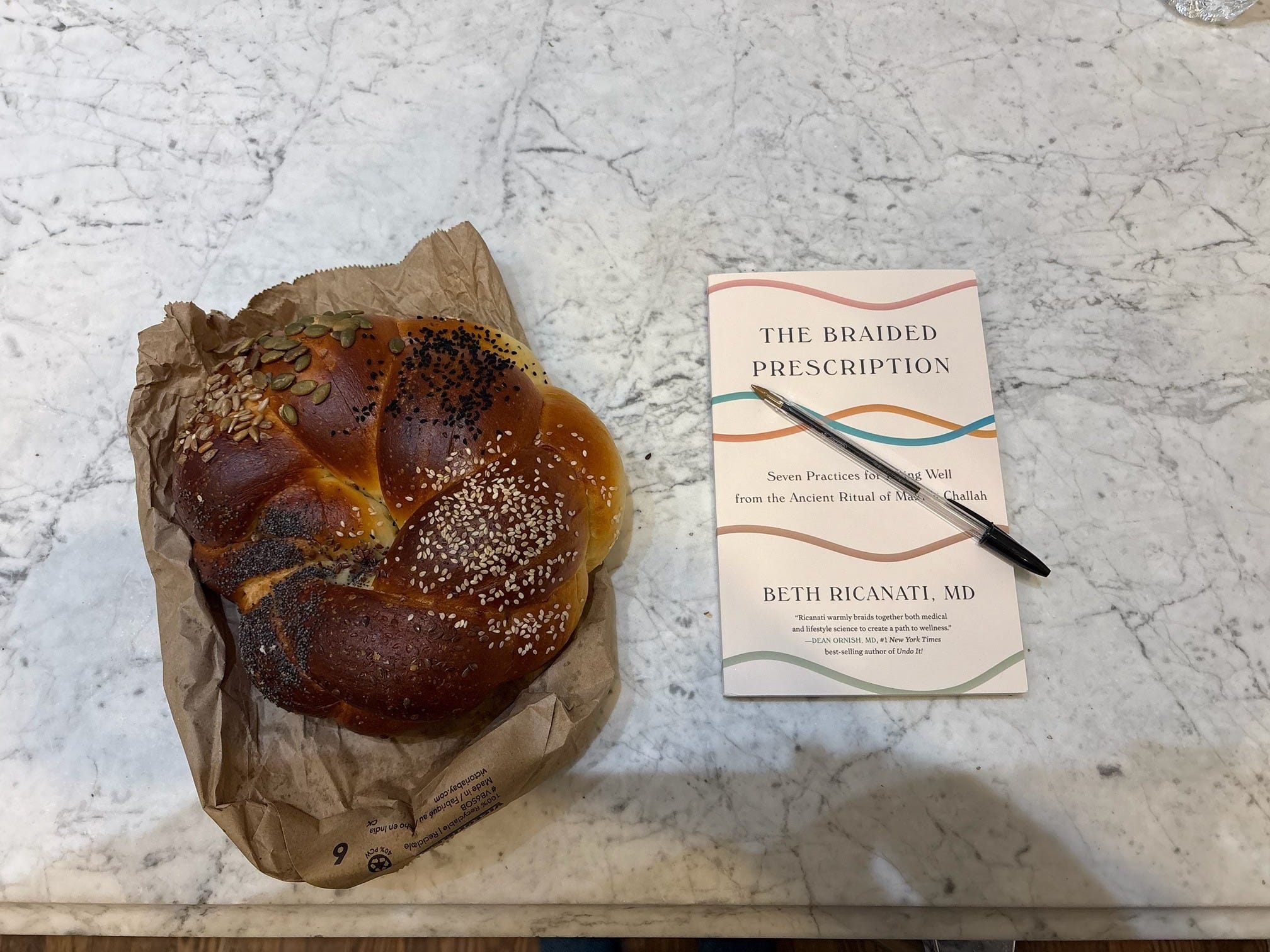
Exactly as I was starting to think more about what human work looks like in the age of AI, I was introduced to Dr. Beth Ricanati from Stephanie Butnick (aka Golda of Golda Guide). Beth is a physician and has practiced medicine in some of the top hospitals around the country. Her personal journey also brought her to the ritual of Challah making which she has come to uncover as a practice that can steady the body, deepen connection and counters our endlessly fast-paced culture. Beth recently captured this framework in her recent book, The Braided Prescription (She Writes Press, distributed by Simon & Schuster) and I had a chance to host Beth for a recent discussion on her work.
Human in The Loop is a spotlight on creativity, originality and uniquely human ideas against a backdrop of infinite technology. This week, you’re reading Cultural Creatives: a spotlight on the creatives doing the hands-on work and the community builders creating new ways to connect. Enjoy!
What inspired you to write The Braided Prescription?
After writing Braided (my memoir, She Writes Press, 2018), I began conducting workshops around the country. This second book is what I learned as a result —- from the workshops, from thousands of conversations, and from readers of the memoir. I didn’t set out to write another book. But after years of watching the same seven practices emerge again and again, I realized I’d been sitting on something. This book is my attempt to distill what those experiences taught me.
Challah-making feels about as far from technology as we can get. Why does it matter right now?
What began as something I did by myself and for myself has grown into something much larger. I’ve come to appreciate how small rituals and everyday practices can help us reconnect — to ourselves, to one another, and to what matters most in our stressful, distracted world. I’ve seen these ideas resonate in synagogues, churches, universities, museums, and around countless kitchen tables — here in America and abroad. This book is one part of that larger conversation: an ongoing exploration of how one ancient ritual can illuminate a more connected, healthier way of living.
“This book is one part of that larger conversation: an ongoing exploration of how one ancient ritual can illuminate a more connected, healthier way of living.”
How do you think about the connection between spiritual practice and creativity?
It feels almost sacred to return Friday after Friday to this practice, especially because each week I bring intention to it. The intention may change, which changes the practice. And I’m not the same person week in and week out. That’s where the creativity lives: the act of making challah is always the same — the same ingredients, the same mixing, the same kneading — and yet each week stands completely on its own. It is never the same.
In a world where technology makes everything infinitely accessible, what’s your process for creating and finding original ideas?
It starts every Friday, with six ingredients and a bowl. Making bread means I am using my hands — no technology in sight. That tactile experience allows me to be present in ways I otherwise wouldn’t be, and gives me space and time to actually think.
What are you reading, watching, listening to right now?
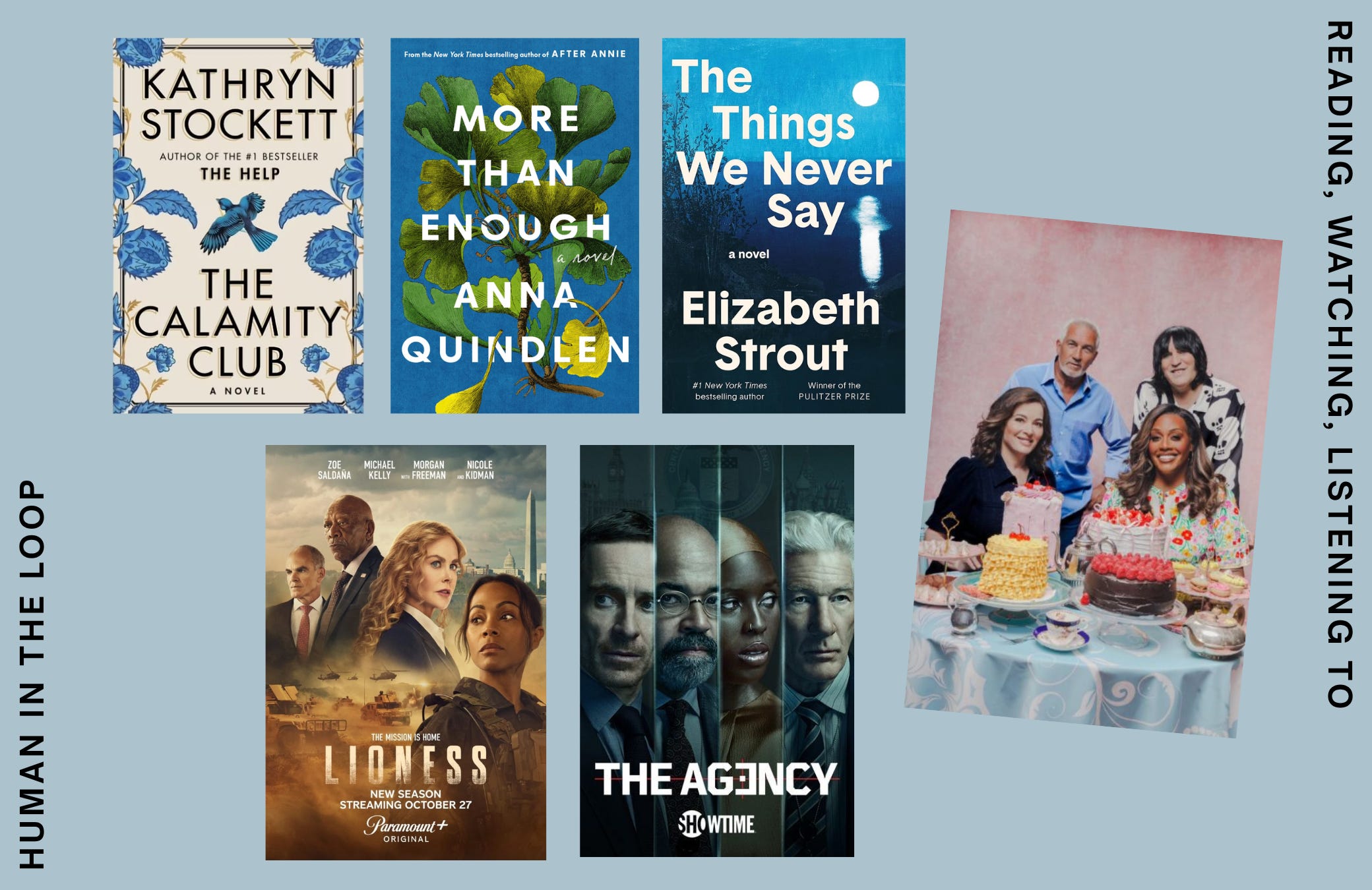
Books and more books, with some binge-worthy TV thrown in. I just finished The Calamity Club by Kathryn Stockett, More Than Enough by Anna Quindlen, and The Things We Never Say by Emma Strout. On TV: The Lioness, The Agency — and I’m counting down for the new season of The Great British Baking Show. The way they cheer each other on? I never get tired of it.
What I’m taking from this:
There is magic in one small practice, done with intention, repeated enough times that it becomes yours.
The ritual isn’t the point. What the ritual makes possible — presence, creativity, and connection — is the point.
Ancient practices survive because they work. When technology accelerates everything around you, slowing down isn’t retreat. It’s a strategy.
more of this!